|
Fault Symptoms
There are a number of symptoms which
may be seen over time. Just one of these faults may be
evident or any combination of these. The faults may be
transient, but if any of these are seen this means that
the camera needs to be repaired and if left unrepaired
the problems will become progressively worse eventually
leading to the possible destruction of the camera!
1. Cooling Problems
Slow or Inadequate
Cooling
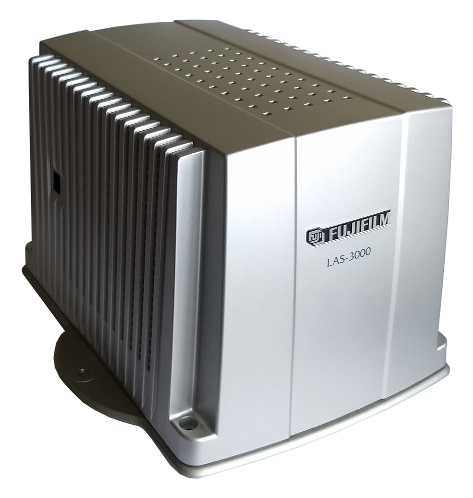
The LAS-3000 camera should be able to
achieve a cooling of -35C. Typical normal operation is
set to -30C, but setting the temperature to -35C is a
good test of the health of the camera. From first being
switched on it should take around 4 minutes to cool from
ambient to -35C followed by around 1 minute further for
the temperature to stabilise (it will initially
overshoot by 1C or 2C). If the peltier cooling device
has become damaged either by a natural component
failure, or more likely due to the introduction of
moisture into the counting chamber, then gradually the
cooling capability of this peltier device is reduced.
Initially the user will see that it takes much longer to
arrive at the working temperature and then progressively
the user must operate the camera at warmer temperatures.
-25C is the warmest the camera can be operated at, but a
repair as soon as a fault is detected is recommended.
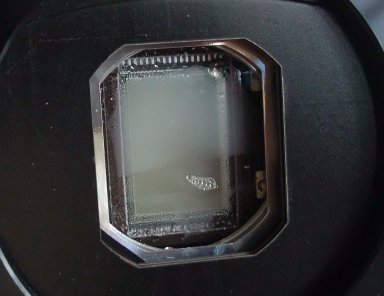
Frosted CCD or
Window
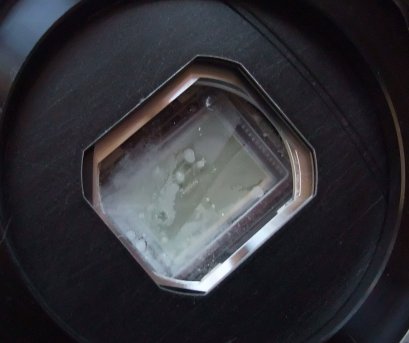
As air is drawn into the counting
chamber moisture in the air can form frost on the CCD or
even the window at the front of the counting chamber.
This will manifest itself as blurred images and greatly
reduced sensitivity. If the camera is allowed to warm
this frosting may evaporate the camera may be cooled
again and the frosting not necessarily re-appear. Of
course with time this frosting will become more
frequent.
Condensation on the
CCD or Window
As air is drawn into the counting
chamber moisture in the air can condense on the CCD and
drop onto the CCD window. Images acquired may show areas
affected by droplets of water, some being quite large
covering up to one third of the image. Of course
condensation also forms at other places in the chamber
which can cause damage to the CCD, peltier cooler or
internal electronics. As soon as this fault is detected
the camera should be repaired.
Oxide Deposits on
the CCD or Window
Moisture in the air drawn into the
chamber can cause oxidation of the aluminium and steel
components which become airbourne and are deposited on
the CCD or window when condensation of moisture occurs.
This manifests itself as blurring of acquired images.
Erratic Temperature
Monitoring
A common problem is the CCD
temperature being displayed with erratic values. The CCD
may operate correctly for a while and then suddenly show
very high or very low values. This is invariably due to
the temperature sensor by the CCD being affected by
condensation or frosting but can also be due to the
semiconductor device itself failing.
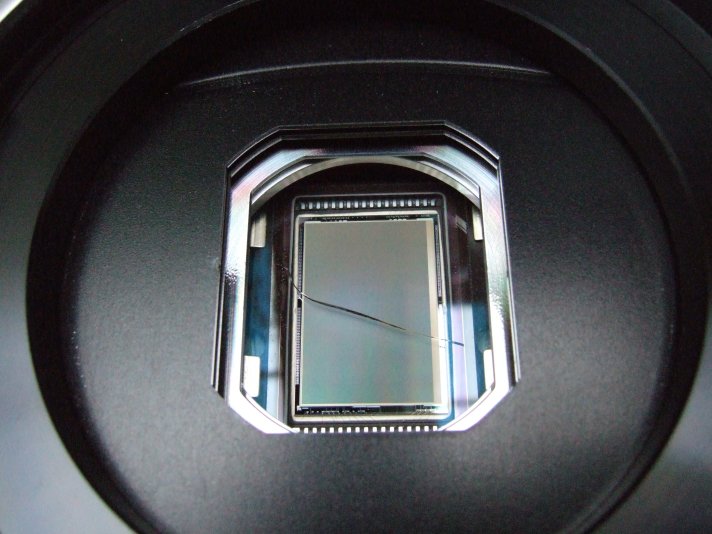
Cracked Chamber
Window
A rare effect is a cracked CCD
window. Well, believe it or not it looks like a crack
but is in fact just an obscure effect caused by the
condensation of moisture on the window. This is easily
cleaned during the refurbishment process.
2. Image Capture
Problems
Blank White Image
When Focusing and/or
Blank White/Grey or Uniform Over-exposed (red) Image
Capture
This fault is caused by component
failure on the internal video capture board of the
camera head. We have access to new stock of these faulty
components and can repair this printed circuit board
in-house on our SMD component rework station facility.
Turnaround time is less than 1 week.
|